Story By Nick Jones
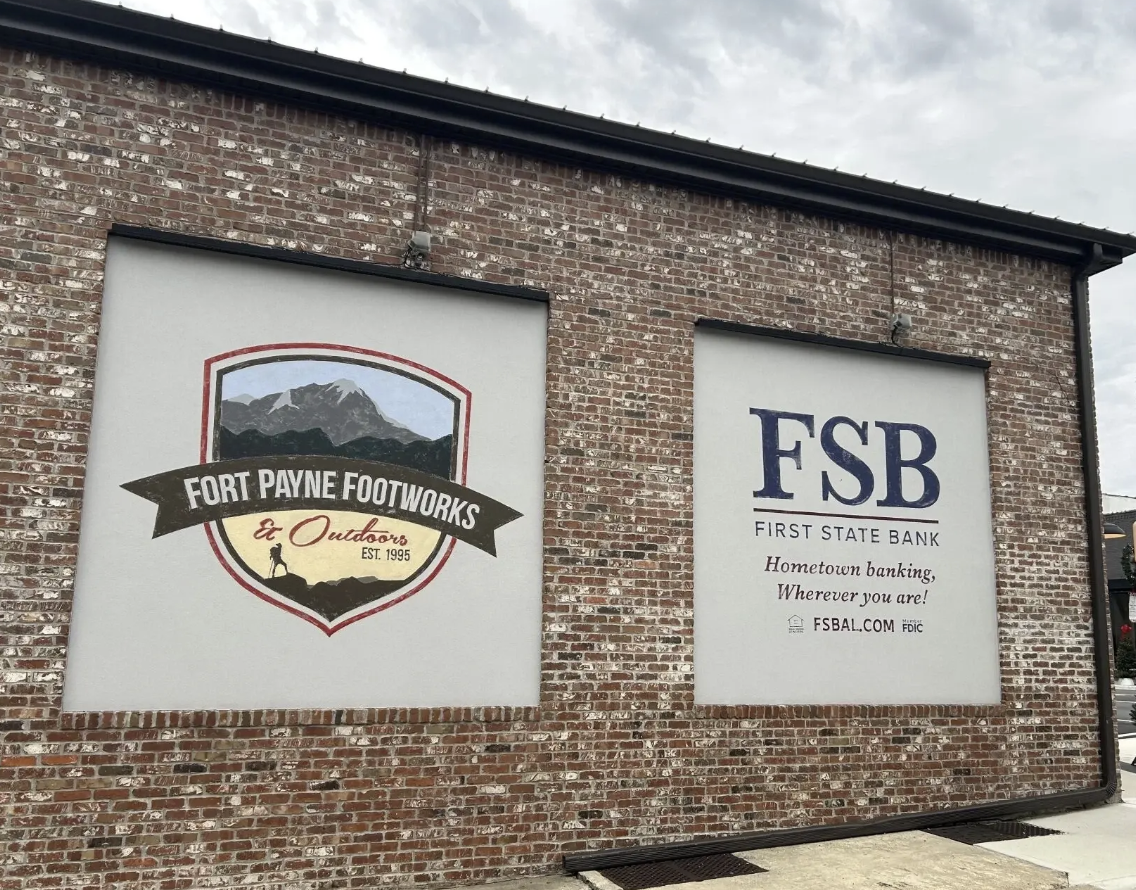
Apparently, in Fort Payne, AL, having a mural on your building has become a crime.
When men with badges and guns, directed by a city mayor and the whim of overzealous law enforcement officers show up at a business office to serve criminal charges, this alone should give you pause. Adding an apparently crazed and obsessed prosecutor who suggests that burying the story in the local newspaper will make resolution much easier should definitely raise eyebrows and begs the question: "Just exactly what is going on here?"
We had a good laugh earlier this week over a well-timed April Fool's prank. I'm sure most of the readers and citizens have at least heard of the criminal charge recently filed against me regarding painted murals on the side of the Southern Torch building. This op-ed is about a few important legal considerations in this country that affect everyone, including you. My hope is that this opinion article develops a public conversation about real reform.

When any government begins using its legal authority to control expression — not simply regulate property — the issue stops being routine enforcement and becomes a constitutional question. The question is simple: Who decides what speech is allowed?
In Fort Payne, City Hall and its enforcement officer appear determined to be the "speech police." Enforcement Officer Nick Brown told me directly that there were complaints received about the murals in question, yet he failed to identify to me who was complaining. The City of Fort Payne, like many municipalities, has adopted an overreaching sign ordinance governing displays and visual communication. On its face, that is not unusual. But a critical part is not just whether an ordinance should even exist; but additionally, it is how it operates.
When a law 1) fails to clearly define a “mural” versus a “sign,” 2) requires approval before expression is allowed, and 3) leaves that approval to discretion rather than objective standards, it raises serious constitutional concerns. Because at that point, the ordinance is no longer just regulating structures; it is regulating speech. The Supreme Court addressed this directly in Reed v. Town of Gilbert. If a law treats speech differently based on its content, it must survive strict scrutiny — the highest constitutional standard. Most local ordinances cannot pass that test. If enforcement depends on what a mural depicts, or how it is interpreted, the constitutional problem is not subtle. It is obvious.
Fort Payne officials have admitted the framework relies on case-by-case approval — a system where expression must be permitted before it exists. That is precisely the type of system the Supreme Court warned about in City of Lakewood v. Plain Dealer Publishing Co. When government officials have unbounded discretion over speech, the risk is not theoretical — it is inevitable. Local case in point: City of Fort Payne v. Nick Jones.
Laws are judged not only by how they are written but also by how they are applied. If murals exist throughout a city, enforcement is triggered selectively — or escalated in certain cases but not others — the issue is no longer compliance, but selective prosecution. The Constitution does not allow the government to favor one speaker over another, as made clear in Police Department of Chicago v. Mosley. Most sign ordinances are enforced through civil mechanisms. But here, in my case, the issue escalates to a criminal charge. That matters. Because when expression becomes criminal, the stakes are no longer administrative; they are constitutional. In Texas v. Johnson, the Supreme Court made clear that the government cannot punish expression simply because it disagrees with it. If that principle applies to flag burning, it certainly applies to a mural on a wall.
This case exposes a deeper issue that cities have largely purposely avoided: Should murals — art — be regulated like signs at all?
A mural is not merely informational. It is artistic expression, cultural identity, and community voice. In Hurley v. Irish-American Gay, Lesbian and Bisexual Group of Boston, the Court affirmed that protected speech includes symbols, images, and artistic works. If that is true, then treating murals as regulatory nuisances rather than protected expression fundamentally misunderstands their nature. Cities often justify mural restrictions in the name of aesthetics. But aesthetics is not a constitutional standard. It is subjective. And subjective judgment is precisely what the First Amendment was designed to limit. Once the government decides what art is acceptable, it has already assumed the role of arbiter of expression.
It is tempting to say, “The ordinance exists. Therefore, it must be followed," and that's exactly what City Hall is banking on. History clearly warns us how dangerous that mindset can be. In Dred Scott v. Sandford, the Supreme Court did not merely interpret a law — it endorsed one of the most grotesque legal frameworks in American history. The Court declared that black people “had no rights which the white man was bound to respect.” It treated human beings as property that could be owned, bought, sold, bartered, and traded like livestock. That ruling was perfectly legal under the framework of the time. It was also morally indefensible and constitutionally catastrophic.
The point is to recognize a fundamental principle: laws are not sacred simply because they exist. Governments pass unconstitutional laws. Courts overturn them. And history often looks back in disbelief that anyone ever defended them in the first place.
Blind obedience to authority has never been a constitutional virtue. Is a mural simply paint on a wall? Or is it also something more? It is a voice. It is an idea. It is a citizen speaking in art rather than words.
When government officials show up with the force of law—with badges, guns, citations, and criminal charges—to decide whether that expression may exist, the issue stops being code enforcement. It becomes far more serious. It becomes the government deciding who gets to speak and who must remain silent.
That is not zoning. That is not aesthetics. That is CENSORSHIP.
If Fort Payne can criminalize a mural today, what will prevent them from criminalizing a message tomorrow?
The First Amendment was written precisely to stop that slide into government-approved speech.
The courts will soon weigh in. And when they do, the question will not simply be whether a city can regulate paint on a wall. The question will be whether a local government can quietly convert your and my rights under the First Amendment from a right into a permit (tax) that we must buy back from the government if they choose to do so. Because once speech must be approved before it exists, freedom of expression is no longer a constitutional guarantee. It is a privilege granted by the very government the Constitution was designed to restrain.
The First Amendment was not written to protect comfortable speech approved by local officials. It was written to protect the speech that the government would most like to silence and suppress those who they may disagree with.
Nick Jones is an entrepreneur, lawyer, and president of Southern Torch which owns the brands of the Times Journal, Sand Mountain Reporter, Jackson County Sentinel, 98-3 Wild Country, 101-7 the Torch, Desoto Printing, and Box & Ink.