Story By Katie Hightower
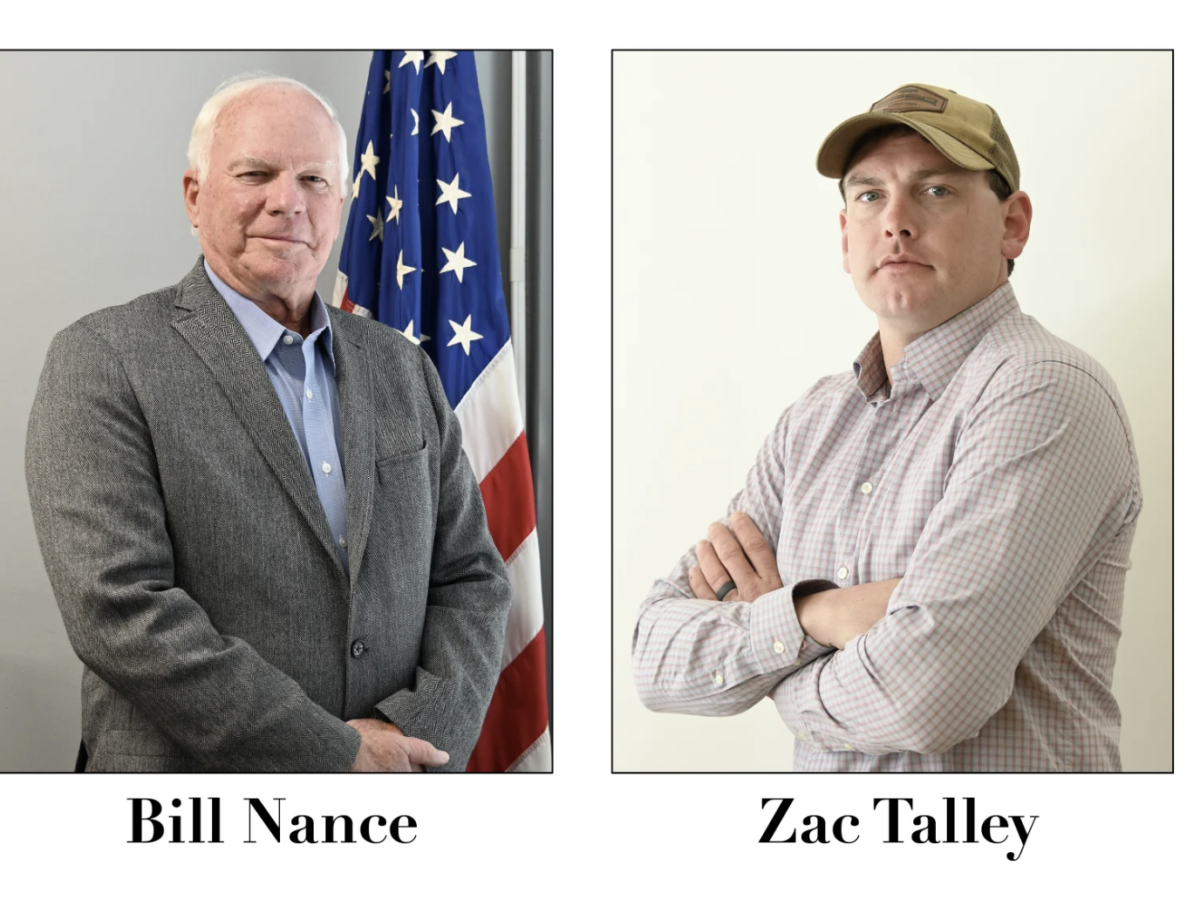
Jackson County voters have two candidates for the Jackson County Commission Chairman. Both candidates expressed a strong desire to serve the people of Jackson County. Sentinel writer Katie Hightower sat down with each candidate to ask the same set of questions about the commission chairman’s role and how they would approach it if elected.
Bill Nance
Bill Nance has served as Jackson County’s Commission Chairman since his appointment in 2021. He was elected to the seat in 2022 and said he wanted to continue his service to Jackson County. Nance said he plans to focus on building Jackson County’s future so that future generations will want to stay and raise their families here.

Nance said the Commission Chairman’s most important responsibility that the public doesn’t see is to provide critical services for the people of Jackson County and to ensure those services’ continuance.
“The chairman is not just responsible for day-to-day operations; the chairman has to be responsible for the future of Jackson County by anticipating changes,” Nance said. “We’re seeing tremendous growth across the whole Tennessee Valley. That growth is in population, manufacturing, housing and almost every sector. It’s very important to the future of our county. So the chairman, I believe, has to be aware of that and has to be looking at what we need to do to make sure we are prepared as a county.”
To prioritize spending if revenues come in lower than expected, Nance said it was best to budget for the unexpected.
“Be conservative in budget planning and by conservative, I mean overestimate expenditures and underestimate revenues,” Nance said. “By doing that, you create a margin in your budget to handle unexpected issues and the funding to be able to handle those situations. For us, it builds up the general fund cash balance and allows us to have a reserve of funds. With the tornadoes of May 2024, we had cash amounts to fund the work necessary to clean up the county. With the slope failures, we were required to fund those road repairs up front. By having a cash balance, we were able to fund those and then get 87% of that money back to replenish the cash balance that we had. So part of funding is to look at the day-to-day operations and have a margin in our funding to not only handle unexpected things but to also have the money available just in case.”
One county expense that Nance said he would handle differently is to increase the county’s support of its local volunteer fire departments and water authorities.
“Though volunteer fire departments get funding from various sources, the ability to provide additional funding for them would greatly improve their ability to respond to emergency situations in their service area. That’s an area where I wish we had more funding to be able to help them,” Nance said. “Another area that we’ve been working to help is our county water authorities. We have areas of the county that do not have county water services and we have areas in the county that could use some refresh of their equipment. Right now, our budget goes to critical services that we are responsible for providing but if we had additional funding, the volunteer fire departments and water authorities would be the services that I would like the commission to help support.”
To balance growth and economic development with protecting the rural parts of the county, Nance said the county put together its Economic Resiliency Plan, which accounted for the county’s strengths. Nance said that residents could access the plan at any time on jacksoncountyal.gov.
“Jackson County is beautiful and has a lot of assets. It’s an attractive place to visit, live and raise families,” Nance said. “It offers amenities through its outdoors: the river, the mountains, biking and hiking. A big contributor to our economy is tourism. So we look to the future and look to maintain that quality of life in Jackson County. With the plan, it gave us implications of growth and how to address it and we reached out to the residents for comment because we want that quality of life and growth.”
When asked how the county should work with municipalities without overstepping them, Nance said it was important to work closely with the municipalities to understand their issues and plans when planning for the future of Jackson County.
“Discussion is important. Whenever the commission does planning for the county, we try to reach out to the municipalities to make them a part of that as we did with our county strategic plan. We asked every mayor for their input into the plan. We had community meetings within the municipalities to get feedback from the residents of those municipalities regarding the plan,” Nance said. “We need to work together because we’re all working toward making Jackson County a better place for all of us to live.”
Nance emphasized that transparency and public communication were critical responsibilities of the chairman.
“I think that is a responsibility as the chairman of the commission,” Nance said. “One of the things I did right after I was appointed by the governor is that I established a citizens’ panel to bring a group of active citizens together from across Jackson County. It gave them the opportunity to tell me what they saw as issues within their area of the county and provide recommendations to me, and I found that to be extremely beneficial. One issue that was brought up in those meetings was the need for broadband. Now Jackson County is probably one of the best counties in terms of access for all of our residents for broadband and internet services. So there’s benefit in getting people together and listening to their concerns and recommendations on what we can do. It has been a great help for me and I enjoy the opportunity to listen.”
When asked how he would handle disagreements with other commissioners, Nance said, “Fortunately, I have not had a situation where I’ve had a major disagreement with a commissioner that created any disruption. My view is every commissioner deserves the right to be able to express their concerns as they see them and we need to take a look at them.”
Nance said that both cell phone coverage and road conditions were long-term issues the county faced that weren’t getting enough attention.
“We need to find a solution to our cell phone coverage across the county. It’s important for the safety and welfare of our citizens of Jackson County. It’s a consistent issue and it’s going to be difficult and expensive but we need to start trying to find a solution,” Nance said. “Another issue that we are working on that is going to continue to be difficult is the roads in Jackson County. With nearly 1,100 miles of local roads in Jackson County, we have roads that have not been touched in 30 or 35 years. Over the last couple of years, we were able to increase the amount of roads that we are repaving to about 25-35 miles per year but that rate is not going to be able to get ahead of the issues we have in the county. We are doing everything we can to get state and local funding and I will say the state has been good to us. Over the last couple of years, we’ve gotten around $1.6 million per year to help us with road projects.”
Nance said he approached the hiring and supervising of department heads as an important responsibility because the department heads are among the most critical positions in the county.
“We have to make sure they have the qualifications that are necessary for them to be able to manage the departments,” Nance said. “We advertise across the county any time we have an opening for a department head and then we have a board of individuals who sit through the interview process and then make recommendations. Then the chairman has to decide to accept the recommendation. Right now, we have a very good slate of department heads.”
When asked what he’d want residents to notice being done differently within his first year after being elected, Nance said he would like to see increased job opportunities and a natural gas pipeline.
“If we can get TVA to approve the pump storage facility, that will bring in a significant number of jobs and if Google can get to the point where they can add buildings on their site, that could lead to more technology jobs. However, one of Jackson County’s weaknesses is the natural gas infrastructure. If we can get a gas pipeline across the northern tier of Alabama into Jackson County, it will help solve some of the issues we’ve been seeing,” Nance said. “So, if we continue to support these projects, corporations and agencies, we’re going to see a lot of job growth and a lot of benefit to Jackson Count.”
Zac Talley
Zac Talley has worked in Jackson County since he was 18 years old when he took a job at his grandfather’s construction company. Talley said he plans to focus on running Jackson County more efficiently so that necessary roadwork in the county can be completed, and he plans to do so with open communication.
Talley said the Commission Chairman’s most important responsibility that the public doesn’t see is to manage day-to-day operations and oversee the budgets.
“The chairman is responsible for overseeing expenses and approving them. I think that’s a crucial part of the job, and it’s just up to the chairman himself to ensure that it gets done,” Talley said. “Add to that, the chairman’s position is more or less the top position in the county. So there’s no one looking over your shoulder making sure that you’re doing your job efficiently. So there’s a lot of responsibility.”
To prioritize spending if revenues come in lower than expected, Talley said he would examine the expenses and income of the county’s departments to make a determination.
“My plan is to run things more efficiently without cutting jobs or raising taxes—working with the amount of money that we already have,” Talley said. “The school system is the number one priority to me, so if there’s anything that would be priority over anything else in general, my answer would be the school system. I know that falls more on the school board than it does with the commission, but as far as making sure that they have everything they need to run efficiently without cutting anything, it would be my priority.”
One county expense that Talley said he would have handled differently was the renovation of the DHR building into the courthouse annex and the addition of the pocket park on the square.
“It seems like if parking was an issue on the square, we wouldn’t add a venue that took up parking, and there could possibly be more details that I’m unaware of. I do agree that the area is congested and something had to be done. To my knowledge, I read that the final cost of the DHR remodel was $1.6 million, but it was $600,000 that the commission estimated. That was done with leftover COVID funds, so it didn’t cost taxpayers or citizens more or less,” Talley said. “One of my top priorities is transparency. I feel like the citizens are not aware. To my knowledge, there was never a public input or a vote to where it would have been discussed on what to do with that leftover COVID response.”
To balance growth and economic development with protecting the rural parts of the county, Talley said he wanted to see the county repurpose empty buildings rather than build new structures.
“We don’t need big corporations; we need efficiency,” Talley said. “I feel like there are buildings owned by cities in rural communities that are vacant. I’d like to partner with those cities to bring in businesses, but not necessarily big corporations, and ultimately, I believe that’s really up to that city. One building that comes to mind is a building in Section that was given to an out-of-state company. It was done on promises for jobs. To my knowledge, they haven’t held their end up on that, and I don’t think they’ve been held accountable either. So that’s a large building that’s sitting vacant that could be used. To sum it up, we need to take what we have available that’s not being used and put it to use.”
When asked how the county should work with municipalities without overstepping them, Talley said it was important to get input from the municipalities’ leaders.
“Go to the leaders of the municipalities—they’re going to know what their city needs, wants, and what’s going to work best for that area. I feel like less government involvement with anything is better. Leave decisions up to that city versus the county commission. At the end of anyone’s term, you want to see progress in a positive way. One of my favorite sayings is that it takes everyone. It feels like the county has had the ball, and then they never started rolling it. We need to start rolling that ball and get something moving forward versus staying where we’re at,” Talley said.
When asked about his philosophy on transparency and public communication, Talley emphasized he wanted to make information and public reporting more accessible to the public.
“When I first decided to run for this position, people complained about the roads more than anything else. I’d like to see a way for citizens to report things like road conditions better. The public being aware of the transparency end of that and seeing their report or their complaint moving up on a list and knowing when it’s coming up does a lot,” Talley said.
When asked how he would handle disagreements with other commissioners, Talley said,
“I, personally, have not seen a disagreement between the commissioners, nor the chairman publicly. I feel like that is a major concern. As these commissioners are elected from their district, they need to be able to put their input in on topics and their ideas on solving an issue. After reviewing the commission meetings, it’s ultimately what the chairman wants is what the commission does, and I don’t know if that’s because they’re not aware of what they can do or if they’re afraid to voice their opinion. As chairman, my role in that meeting is to make an agenda but to also open discussion. Each commissioner should be able to voice their opinions without fear of backlash from the chairman or any other commissioner.”
Talley said that the shape of Jackson County’s roads was a long-term issue that the county faced that wasn’t getting enough attention.
“I believe our county roads are horrible, and at some point in time you have to make progress. You have to get the ball rolling. By no means are we going to increase taxes to pay for these roads,” Talley said.
“It goes back to where efficiency is key to that. The road issue is something that has gone on as long as I can remember, and I don’t ever remember it getting better.”
Talley said he approached the hiring and supervising of department heads through the examination of a candidate’s qualifications and leadership skills over seniority.
“Seniority has a lot to do with this now. I’m not opposed to that. With that being said, if there’s someone in that department that’s not been there as long as someone else but is more qualified for that position, then it needs to be considered. I know that employees in that department have better knowledge of what goes on there, so I wouldn’t be opposed to recommendations. I know that if you put someone in a leadership role that is not a leader, that will destroy a department,” Talley said.
When asked what he’d want residents to notice being done differently within the first year, Talley said he would like to see more discussion and transparency.
“I want the public to say, ‘Wow, we know what’s going on.’”