Story By Hunter Jones
On Friday, the Scottsboro Boys Museum opened an exhibit honoring Sheriff Matt Wann, who famously ensured the Scottsboro Boys following their arrest, breaking up a lynch mob and allowing the nine to make it to court and have their story spread throughout the world following the trial.
Scottsboro Boys Museum Executive Director Dr. Tom Reidy started by talking about his first time hearing of the Scottsboro Boys and how instrumental Wann was to the story.
Reidy then shares how he believes Wann saved the boys three times rather than the one time that is typically known.

First, the Scottsboro boys had gotten into a fight earlier that night with a group of six white men. While no serious injuries occurred, the six white men were thrown off the train and went to the Stevenson Depot to report that the Scottsboro Boys were on a train with two white women. From there, a call came to Wann. By the time they reached Wann, the train passed through Scottsboro and was stopping next at Paint Rock. Reidy explained that at the time, Wann was already busy, with Wann working constantly to bust up distilleries during the Prohibition Era. Wann, understanding the situation, sends a deputy to Paint Rock. When the deputy arrives, there are already 100 to 150 men gathered at the train, already worked up with ropes in hand.
“The timing of that was critical. 10 minutes later, we don’t know if we (the Scottsboro Boys) again,” Reidy said.
After the nine are arrested following an accusation of rape, the nine are brought to the county jail, where another large crowd gathers. Wann and three deputies are alone in the jail against an angry crowd that likely outnumbers them 100 to one. The deputies insist to Wann that they need to get the boys out of the jail but Wann refuses. One of the deputies comes up with an idea, to separate the boys and each deputy carry out three before Reidy states that Wann saves their lives for the second time that night.
“No, that’s the dumbest idea I’ve ever heard,” Wann said.
Wann believed that if they separated, it would just make them easier targets. Then, Reidy describes what he calls Wann’s Atticus Finch moment. Wann decides to walk out with a shotgun in hand and tells the crowd to go home and that anyone who crosses him will be shot.
Reidy explains that Wann is not a career law enforcement officer. He runs a mercantile in Pisgah. He knows the people in this crowd. Reidy believes that Wann commanded enough respect in the community that he may not have needed the gun.
“He just knew people, he knew the community, he was raised there. They knew him and they trusted him,” Reidy said.
Wann then called the National Guard for support. The next morning, the Scottsboro Boys are being transported to Anniston to the Etowah County Jail for security reasons. The driver of the prisoner transport, seeing the crowd around the jail again, decides to drive down a block and a half, stops and pretends he cannot start the car. Wann yells at him to continue. The driver does the same stunt again and the crowd begins pushing on the car. Wann physically moves people from the car and while Reidy says there is no record of what was said, Wann got the driver to move and not stop again.
A year after the incident, Wann was serving a warrant for Harry Hambrick, charged with abandoning his wife. Wann and several deputies get there that night, surround the house and Wann knocks on the door to execute the warrant. Hambrick’s brother, the owner of the home, comes out and Wann mistakenly goes to arrest him. One of the other deputies saw Harry in the house, armed with a gun and yelled at Harry to put the weapon down. Harry goes to the front door, shoots Wann fatally and runs away. Hambrick was never found again. Wann was 55 years old.
A lot of controversy surrounds the shooting, some believing that this was retaliatory following the Scottsboro Boys case getting as famous as it did and “making Scottsboro look bad.”
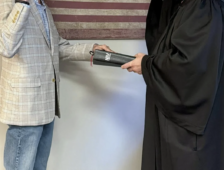
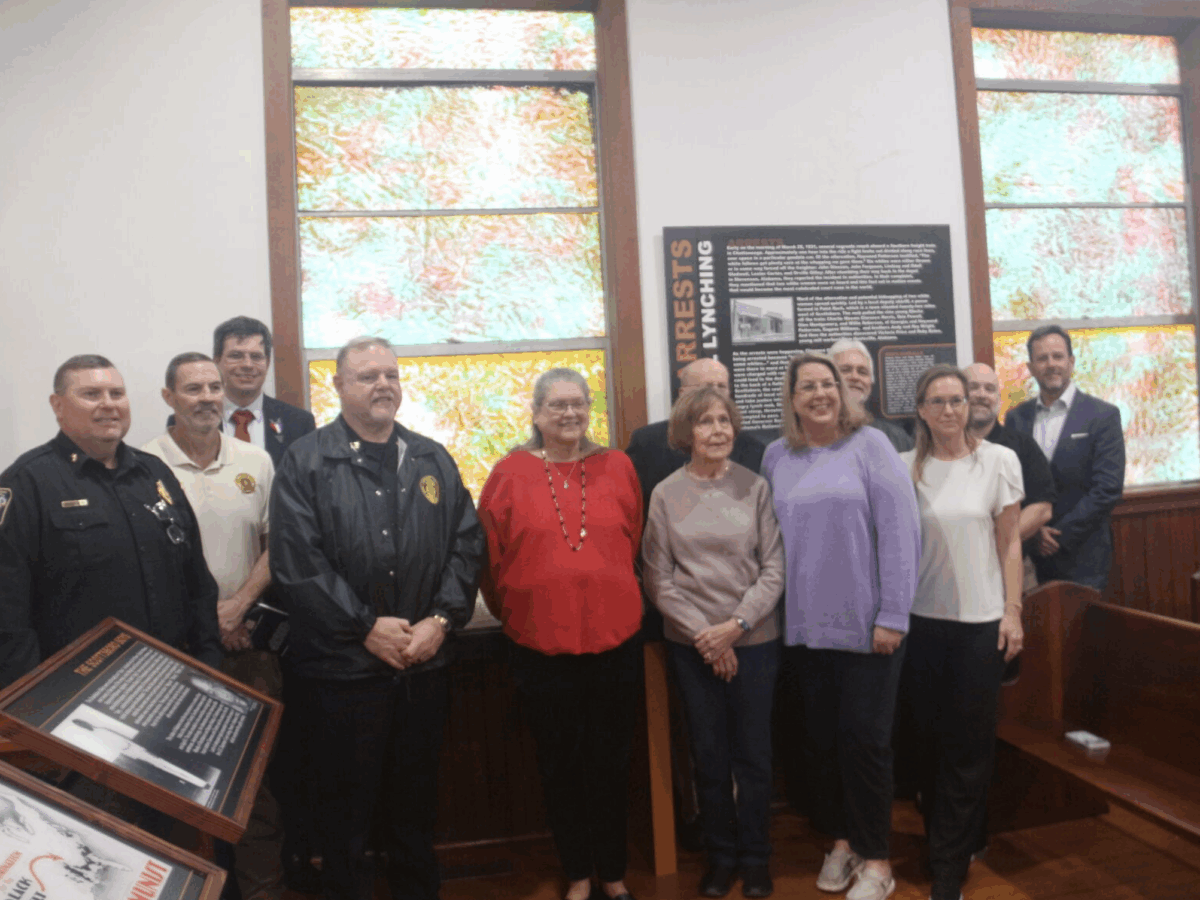
Nearly 95 years later, Wann’s badge and gun are now displayed in Scottsboro Boys Museum. Members of the Scottsboro Police Department, Jackson County Sheriff’s Office and Wann’s grandson and great-grandson, Billy and Matthew, are present for the ceremony, with Billy, Matt and Sheriff Rocky Harnen speaking. Harnen stated that officers are often not recognized for doing the right thing and that today is happening because Wann did the right thing.
“I see (Wann’s) picture on the wall every day with all the other sheriffs and I did know that he was only there for about a year because he was murdered shortly after this happened… When I found out about this, I realized that he was the one who stood up against the lynch mob,” Harnen said. “(Wann) did the right thing. No matter what color, race or creed you are, you have to defend those people, that’s your job. Everybody who gets arrested is not necessarily guilty… He stood up for (the Scottsboro Boys) and that was tough back then,” Harnen said.
When Billy speaks, he shares the story of him trying to get his grandfather more recognition, with Billy seeing so many pieces of media on the Scottsboro Boys not mention his grandfather’s actions.
Billy recalls a documentary where his family was interviewed for “Scottsboro: An American Tragedy.” Billy says that they were all interviewed for a “long time” however when it got to them, it was cut to about 10 seconds. Regardless, the story of the Sheriff, unnamed in the documentary, was told. While it was progress, Billy continued to advocate for his grandfather’s role in the story.
Billy recalls first meeting Scottsboro Boys Museum founder Shelia Washington, who was happy to assist in Billy’s goal of getting his grandfather’s part in the story shown, sharing the story of Washington trying to push for Billy to find a photo of Wann they can use for the museum, which he later found by accident after a slide fell out of an old envelope.
“Today means a lot. I’ve worked on this for a long time. This is much better than I expected,” Billy Wann said. “We are very thankful for all these people and law enforcement who attended.”
The gun was donated by Billy’s sister while Matthew donated the badge.
Matthew Wann, named after his great-grandfather, shares that his dad passed away three years ago, last seeing the museum before it’s renovation and that his father would have been blown away by how it looks. Matthew decides to share some lighter stories he heard about his late great-grandfather. First, Matthew reads from a write-up of Wann from the Sentinel in 1971, where Wann was described as well-liked by the community, the last to lose his temper or get excited, fair with arrests and keeping prisoners and “too good to be sheriff.”
Matthew described his great-grandfather as fair but not soft in his duties, with Matthew noting that Wann never drew his pistol when he was killed, saying that it was still in his holster when he was found dead. Matthew finds a lot of Sheriff Taylor from The Andy Griffith Show in his great-grandfather, stating that “they respected the man, they didn’t fear the gun.”
Matthew then shares a couple stories that he found humorous, including a night where a prisoner tried to escape the jail using bedsheets to climb down. Wann saw this, grabbed his gun, went outside and fired a shot underneath where the prisoner was climbing. The prisoner climbed up back into his cell. Another time, Wann was making the rounds and checking on prisoners when one jumped on him, threw him in the cell, grabbed his gun and ran off. While Matthew is unsure if the prisoner was caught, he does know that the prisoner mailed Wann his gun back. The final story is when Wann was breaking up moonshine distilleries, he would crush them and stack them up behind the jail. Matthew’s grandfather, 11 at the time, decided to take little bits of liquid from the crushed stills and give it to a rooster that lived in the jail yard. Matthew said that a few minutes later, the rooster was stumbling around, which his grandfather found hilarious. The next time he tried to do this, the rooster came running to him.
“I grew up hearing those stories from my grandfather. (It was important to me) to show who he was overall. It’s easy to put him on a pedestal and hero worship them but it’s a little bit harder to picture them in their everyday lives and what they did that doesn’t deserve recognition. I think those (stories) go towards illustrating who he really was as a person,” Matthew Wann said.
Now, with Wann’s gun and badge being displayed in the museum, the man who helped get the Scottsboro Boys to trial can be honored in the museum documenting the boys he chose to save.