Story by Marla Ballard Special to the Times-Journal
According to Matthew Webb, Jackson County Extension Director “We are in mud season and mud affects livestock, but there are strategies that help.”
Webb said there is research that indicates that the depth of mud has a definite effect on livestock performance. The study was done on growing cattle and revealed that if mud depth was only 4 to 8 inches deep, the daily liveweight gains were reduced by 14%.
The extra work of stomping and pulling their feet through the mud to travel to the feed bunk required too much extra effort. As a result, the cattle ate eight to 15% less feed per day. As depth of mud increased to 12 to 24 inches, cattle performance continued to decline with daily gains falling by 25% and feed intake dropping by 30%.

Calculating the exact impact in dollars is difficult due to the fact that there is not much written on the matter. Webb said just using cowboy math and an average of current cattle prices as an example it can help cattlemen see some results that could occur.
“Assume growing cattle are being marketed at a price of $3 per pound. If we hypothesized a one-pound per day gain, but a daily loss of 14% due to mud, the cost would be 42 cents. Over a 100-day feeding period that would be a loss of $42 per steer,” said Webb. “Most cattle producers in our area are cow/calf operators, but we know that a declining body condition in cows can lower the chances of cattle getting bred and affect the number of calves born and the timing of those calves being born. It is possible some calf mortality could occur just from young calves becoming stuck in the mud and inadvertently trampled by bigger animals. Of lesser concern would be foot problems, such as foot rot and scald, which could become a problem.”
Webb said there is more than one strategy for managing mud on farms, but like anything on a farm/ranch there will be a cost of construction and implementation. However, with planning and proper execution, the operation can be more efficient.
Strategy’s Webb suggested included moving hay feeders and bunks when mud starts to become a problem or unrolling hay into the field. However, Webb said farmers should be aware that these techniques can result in pasture damage, so these practices are best done on areas where soil fertility is lower or weed pressure is greater and the field is a candidate for renovation.
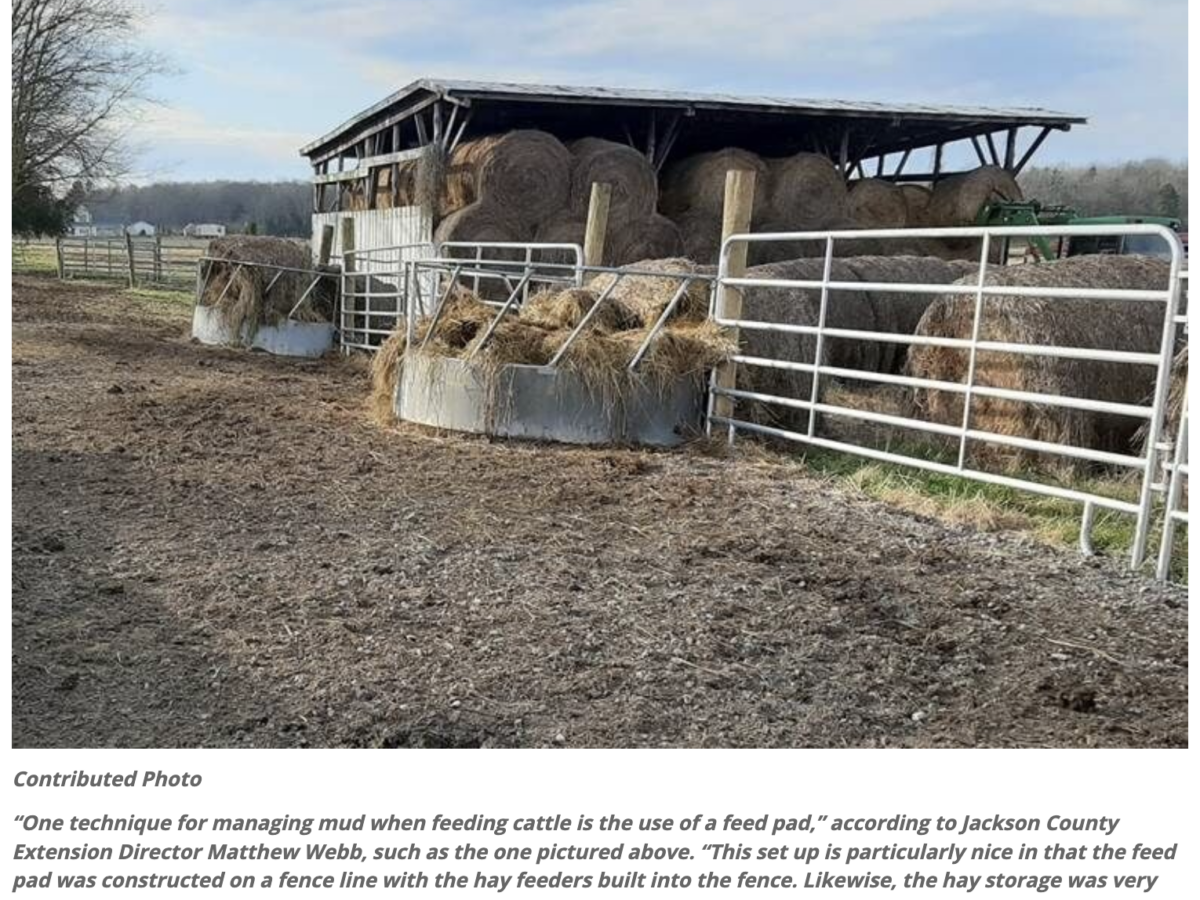
Another suggestion Webb offered is using a feed pad, especially if it can be constructed with concrete instead of chert or gravel. Webb said farmers would be surprised how much better cattle will perform and how much feed is utilized if cattle can feed on a solid surface during wet winter weather.
An additional step for the feed pad option is to put the feed pad along a fence line and set it up where the cattle are on one side of the fence and the operator is on the other side during feeding time,” said Webb. “This will result in everyone being safer and feeding will take a lot less time.”