Story By Hunter Jones
The Scottsboro Boys Museum is completely full. Not a seat open on the pew benches from the former Joyce Chapel building was left unfilled. A few folding chairs were set up near the back of the museum for those remaining to try and grab a seat. Those, too, quickly filled.
As the time came for the program to begin, Lydia Pennington takes the stage. She first talks about the history of the building, with the land coming from a former slave’s donation to establish Joyce Chapel. She then mentions the museum’s renovation, stating that since re-opening in 2022, 7,000 visitors from 42 states and 31 countries have visited.
“The footprint of this museum really stretched far and wide,” Pennington said.

Museum Director Dr. Thomas Reidy then came up and spoke to the crowd, going over the history of slavery, Juneteenth and the Scottsboro Boys.
After him, Melissa Julia spoke about a current criminal justice issue with the case of Toforest Johnson. Johnson was arrested and found guilty of murdering a police officer in 1998 at 15 years old, however much of the evidence to put Johnson on death row is believed to be insufficient, with no eyewitness testimonies, with the sole witness being a woman who had never met Johnson, claimed to overhear him confess on the phone and was paid $5,000 for her testimony, a fact not revealed to Johnson’s attorney until nearly 20 years later. Many notable figures in Alabama, including keynote speaker for this event Bill Baxley and the trial prosecutor, has endorsed a petition for the case to be retried.
“Over the years, dozens and dozens of people have things they sent me saying somebody on death row needs help. I have never seen anybody that got the death penalty that was innocent except the Scottsboro Boys,” Baxley said. “(After reading over the case files, Toforest Johnson) is the second innocent person.”
When Baxley came up to speak, he was introduced to much applause. Baxley was the man who got the last surviving Scottsboro Boy, Clarence Norris, pardoned in 1976.
Baxley shares the story of how it happened. As the youngest attorney general, he was informed that Norris was alive and living in New York. He then began to petition the parole board for Norris’ pardon.
Baxley was contacted by someone from the NAACP about Norris, who had been on escape for nearly 30 years, living in New York and using his brother’s identity. After moving to New York, Norris found a job, got married, had two grown children and never been in trouble. He wanted to receive a pardon before he passed away. Baxley assigned Milton Davis to review what the NAACP had to review regarding the case, spending four months researching it to prove that Norris was innocent. When Baxley was educated on the case, he was stunned.
“I could not believe that they had been found guilty. I could not believe they were charged. I could not believe that it happened, even in the 1930s in Alabama,” Baxley said. “There was no question, no even close question about the guilt or innocence of the Scottsboro Boys, that did not happen.”
After proving his innocence, Baxley and the NAACP put together a package to try and petition the parole board to pardon Norris. Baxley quickly got support of all but one member, who did not want to pardon a man currently on escape. The last vote said that they could not conduct a hearing for a man on escape and that Norris would have to turn himself in and go to prison before then.
“Needless to say, Clarence Norris did not have enough trust in the Alabama Judicial System to turn himself in,” Baxley said.
The others were sympathetic to Norris’ position, understanding his distrust at the prospect of turning himself in. Baxley then prepared the package for Governor George Wallace. Wallace, admitting that he was not sure if he had the time to look through it all, simply stated that if Baxley reviewed all of this and believed they were innocent, he would not question it. When Baxley informed Wallace of the one person not on board with the pardon, Wallace said that he would reason with him. Baxley soon received word that the lone vote he needed would be approved.
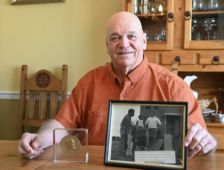
Norris traveled down from Atlanta, met with Baxley, signed the paperwork to turn himself in and within seconds, was a free man for the remainder of his life. Baxley then holds up a picture of Clarence Norris in Baxley’s office with several other people after Norris had been pardoned, with an inscription at the bottom, reading “for a man who seeks the truth”, with Norris’ name signed.
Baxley calls the picture one of his favorites. He then shares his story of coming to learn the Johnson case, signing a petition for a re-trial and reaching out to former colleagues to do the same. Even now, Baxley continues to seek justice for who he believes to be innocent.